
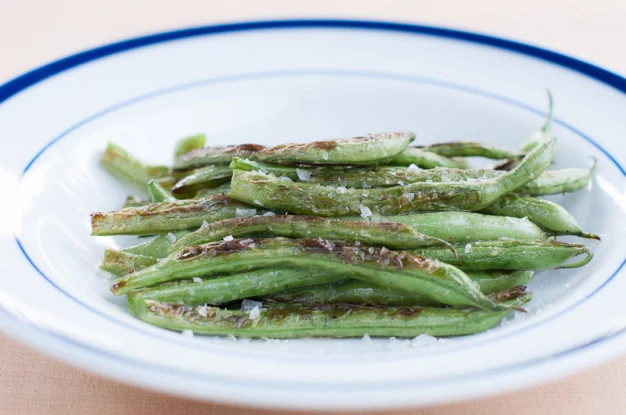
The Secret to Perfectly Roasted Green Beans - Recipe
Microwave green beans for about 2 minutes to par-cook them, then sear them in a very hot cast-iron skillet for about 3 minutes until they have caramelized brown spots.
- Serves
- 4 as a side dish
- Time
- 15 minutes
- Microwave
- about 2 minutes, 1 minute at a time
- Sear
- about 3 minutes
- Diet
- Vegetarian, vegan, gluten-free and kosher
The problem with roasted green beans, whether you do them in the oven or in a hot skillet, is to get those beautiful, caramelized brown spots on the surface of most of the beans without either over- or under-cooking the insides. Run the heat too high and you’ll burn the outside before the inside is done; run it too low and you’ll end up with mush.
The solution is simple, but it involves a two-step cooking process and a tool so feared, hated, and misunderstood that I’m almost afraid to whisper it’s name. Because every time I do, I get comments telling me that I’m poisoning my food, destroying the nutrients, etc. etc. But science must persevere, people. That tool is: the microwave.
Now take a deep breath. I won’t bore you with all of the facts, but let’s just hit a couple. Microwave ovens use, you guessed it, microwave radiation. Microwave radiation is not any form of nuclear radiation. It doesn’t make your food radioactive, not even a teensy little bit. It is electromagnetic radiation. You know: like light, and radio waves. A microwave oven works by exciting the water molecules in your food, which heat up and cook the surrounding material. So it is akin to steaming or boiling but with the marked advantage that food cooks inside as much as outside. Evidence is that, used correctly, it actually retains more of the nutrients in food than more conventional cooking methods.
Then there are the folks who aren’t scared of microwaves, but think they only are used for heating up desperation frozen meals. But that, again, is a misunderstanding. The biggest problem with the microwave is the same as with boiling or steaming. It makes your food tender and cooked, but since nothing goes above 212 F / 100 C, you don’t get any browning. This is where the two step cooking process comes in. We’ll use the microwave to par-cook the green beans, then finish them quickly in a wicked hot skillet. By separating the cook-through and searing steps, we get to control both aspects.
Interestingly, I know I’m not the only person who uses this method (not just for green beans - I often do it with carrots, broccoli, small potatoes, etc.), but I rarely if ever see it mentioned in cookbooks. My old friend Spike works this way a lot, I know, because we’ve exchanged several emails on the subject. Any other microwave & then sear aficionados out there?
Once you’ve got your caramelized green beans, you can either stop right there and finish them with Maldon salt and some good olive oil, or you can take them in any flavor direction you like. For example, glaze them with a bit of sherry vinegar and smoked paprika for a Spanish approach, or with lemon juice, garlic, olives and feta to head to Greece. (Stop a little early on the sear if you do this; otherwise when you add a bit of liquid they tend to overcook.) If you are making a stir-fry and don’t have a jet-sized wok burner, the same trick works - microwave the beans to nearly tender, then finish in a hot wok.
- 1 pound of green beans
- Vegetable oil
- Kosher salt
- Sea salt, preferably Maldon
- Extra-virgin olive oil
- Trim your green beans. I like to remove just the stem end, but if you want to do both ends that is ok too. By the way, try doing this task with kitchen shears. I find it to be much faster than with my knife.
- Preheat your largest skillet, preferably cast iron, over high heat. (Don't do this with a non-stick pan, it isn't safe at these temperatures.)
- Rinse the green beans and leave a bit of water clinging to them. Place them in a microwave-safe bowl with a lid and microwave on high power for 1 minute, then carefully toss with tongs and return to the microwave. Repeat the covering, microwaving and tossing 1 minute or less at a time until the beans have turned a brighter shade of green, but with still have a noticeable firmness about them. In my microwave the total time is only about 2 minutes.
- Leave the skillet on high heat. Add a couple of tablespoons of the vegetable oil to the skillet and immediately add the beans, using tongs so as to leave any water behind in the bowl. Add a big pinch of Kosher salt and toss the beans, then spread them out evenly in the pan. Cook, tossing only occasionally, until there are many browned spots on the beans, about 3 minutes
- Transfer your beautifully caramelized green beans to a serving platter and finish with a drizzle of extra-virgin olive oil and a nice scattering of sea salt.
Frequently asked questions
How long do you microwave green beans?
About 2 minutes in total in the author's microwave. Microwave covered on high for 1 minute, toss, and repeat in bursts of a minute or less until the beans are a brighter green but still noticeably firm.
Why microwave green beans before roasting them?
Roasted green beans are hard to get right: high heat burns the outside before the inside is done, and low heat makes mush. Microwaving par-cooks the beans, and a quick sear in a very hot skillet then adds the caramelized spots. Splitting the two steps gives you control over each.
How long do you sear the beans?
About 3 minutes in a screaming-hot cast iron skillet with a couple of tablespoons of vegetable oil, tossing only occasionally, until many browned spots appear. Don't use a non-stick pan at these temperatures.
Does microwaving destroy nutrients?
The author notes that microwave radiation isn't nuclear radiation and that, used correctly, microwaving retains more nutrients than conventional cooking.
Does this work for other vegetables?
Yes. The same trick works with carrots, broccoli and small potatoes, and for stir-fries when you don't have a wok burner.
This post contains affiliate links; if you buy through them I may earn a small commission at no cost to you. Learn more.
More like this: Vegetarian Thanksgiving Recipes: Sides and Showstoppers
20 Comments
Comments are closed.