
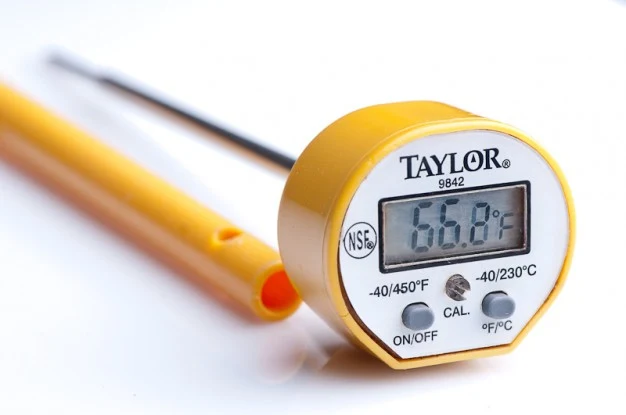
Why You Need an Instant-Read Kitchen Thermometer
This post contains affiliate links; if you buy through them I may earn a small commission at no cost to you. Learn more.
An instant-read thermometer might seem like one of those kitchen gadgets you don’t really need. Most of us cook by the seat of our pants anyhow, right? Maybe it seems a little too “cheffy?” But I think you’ll find that if you get one, even a basic $12 model like I have pictured above, you’ll use it a lot, and it will increase your confidence in a wide range of kitchen tasks. See below for reasons you might want to get an even better one.
Here are some of the things I use an instant-read thermometer for:
- Checking to see if oven-baked food like lasagna is hot enough to serve (160 F is great; 140 F will do if you are in a hurry)
- Making sure custard isn't overcooked (if you get to 185 F the egg proteins will get very tough)
- Food safety 101 - if you are going to keep something perishable out of the refrigerator for an extended period of time it must be below 40 F or above 140 F
- Food safety 102 - make sure anything with egg yolks reaches at least 160 F to kill salmonella (especially if it will be served to the young, old, or immunocompromised)
- Checking refrigerator temperature - just stick it in your soymilk or pickle jar for a second. Try it on a few shelves, you might be surprised at the variation.
- Oil temperature for deep frying
- Sugar temperature for candy
- Bread is done at about 205 F (no more knocking on the loaf and listening for a hollow sound); quickbreads around 195 F
Update, 10/18/2012
I had originally mentioned that there is a more expensive Thermapen model that many people seem to like, but that I hadn’t tried it. A few commenters said they loved theirs, and then Jesse who works for Thermoworks offered to send me one. It arrived yesterday and I spent a little while playing with it and comparing to the Taylor. There is no doubt, it gets to a reliable reading much quicker than the Taylor. It really does get within 1 degree of the final temp in just 3 seconds - a substantial advantage when you need to test the same custard or candy multiple times.
You’ll love the owner’s manual - you can tell right away these guys are temperature geeks, passionate about helping you get your food safe and delicious. Exactly the kind kind of people I like to work with.
I tried the Thermapen on a carefully made ice bath and boiling water, and it literally nailed 0 degrees C and 100 degrees C. I had recalibrated the Taylor and it was hitting 0 accurately, but reading 101.5 C for the boiling water. So the thermapen is both quicker and more accurate.
My only nitpick: you can choose between Celsius and Fahrenheit, but only by setting a switch in the battery compartment. I have some temps in my head in C and some in F - e.g. I remember food safety in F (40 - 140 being the danger zone), and others, like egg and sous vides done-ness in C (62 C soft-boiled eggs are awesome). So I wish the Thermapen offered an external switch. But overall I think it is clearly a much better tool and worth the additional money.
I wouldn’t especially recommend the infrared models where you just point the thermometer at the food to get a reading. Those only read surface temperatures, and for most uses that I’m interested in, I need to know what is going on in the interior.
What do you think? Do you use an instant-read thermometer? If so, tell us which model you have and why you do or don’t love it. And if not, why not?

16 Comments
Comments are closed.