
Cold Carrot Soup - Recipe
This post contains affiliate links; if you buy through them I may earn a small commission at no cost to you. Learn more.
You’ve probably heard that Dr. Nathan Myhrvold, the CEO of Intellectual Ventures and former CTO of Microsoft, along with Chris Young, Maxime Billet, and a cast of dozens, is publishing the most anticipated cookbook since Apicius. (If not, here is the background.)
I’ve had the great good fortune to hear Dr. Myhrvold speak about the book on three separate occasions lately; first at the International Food Bloggers Conference, next when he visited my work at Adobe as a Distinguished Lecturer, and finally at a launch party at Tom Douglas’ Palace Ballroom. Amazingly, he’s managed to keep changing up the talk so that I’ve seen new stuff every time. I also got to have lunch with him during the Adobe visit. He’s a very down-to-earth, approachable, passionate, likable guy.
At the last talk, he described a method for making intense and purely flavored, somewhat caramelized vegetable soups using a pressure cooker. He didn’t give the exact recipe that is in the book, but the description was clear enough that I was able to do it on the first try at home. The key is that the vegetable (carrots, in this case) are pressure cooked with no added water to dilute the flavor. When they are cooked, you puree and strain the carrots and then season and add accompaniments as you see fit.
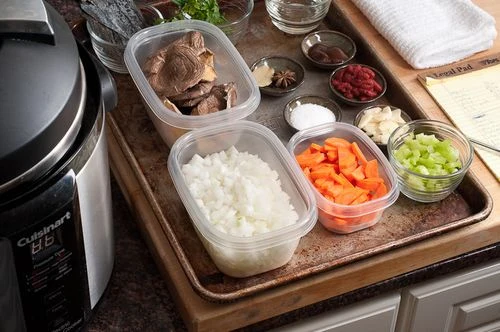
Several folks have expressed concern that this method would cause burning. I didn’t experience that at all in my pressure cooker, but a friend tried this and indeed had some pretty bad burning. Both cookers are electric, but mine is a modern Cuisinart, while his is a 1960s era-Presto. One difference is that mine has a non-stick pan while his doesn’t. It is also possible that the modern pot has better temperature regulation. In any case, this is an experimental recipe so I’ll have to say: your mileage may vary!
I’m not completely clear on the science behind the caramelization here. The sugar in carrots is mostly sucrose, which normally caramelizes at 160 C. Pressure cookers typically only reach around 122 C. There is some fructose present, which will caramelize at 110 C. So I’m not sure if the caramelized flavor is coming mainly from the fructose, or if the caramelization temperature of sucrose is lower under high pressure.
What I can tell you is that the soup is, if I may speak technically here for a moment, freaking delicious. You taste only two things: purest essence of carrot, and a warm brown underlying caramel, seamlessly woven together. You can eat it hot or cold, plain or adorned.
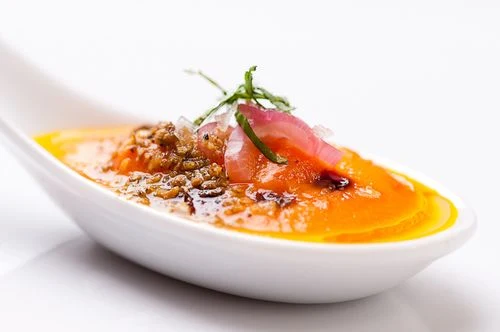
For today’s version, I’ve chosen to serve the soup cold as an amuse bouche, with olive oil, pomegranate molasses, dukkah, pickled shallot, cilantro, and Maldon (aka the world’s greatest salt) .
(If you don’t have a pressure cooker, I highly recommend this electric model from Cuisinart; it manages the temperature and pressure by itself, has modes for searing, sauteeing and simmering which are useful before and after pressure, and cleans up easily. Once you have a pressure cooker you’ll find any number of uses for it.)
(Update: I’ve since learned that my estimated version of this soup, from before I owned Modernist Cuisine, is missing some key things, like a bit of baking soda. But it was still delicious!)
For the soup:
- 2 pounds sweet, delicious carrots, trimmed, peeled and cut into 1/2" coins
- 3 tablespoons extra virgin olive oil
- Kosher salt
- extra virgin olive oil
- pomegranate molasses
- dukkah
- small, thin rings of shallot briefly pickled in hot sherry vinegar (microwave works great)
- micro-cilantro, or regular cilantro leaves chiffonade
- Maldon (aka the world's greatest salt) salt
- Please read the full headnote above for some caveats. Put the carrots in the pressure cooker. Don't add water or anything else. Cook at high pressure for 30 minutes. Release the pressure. Remove the carrots, allow to cool for a few minutes, add three tablespoons olive oil, and then puree as thoroughly as possible.
- Pass the carrot puree through the finest sieve or tamis you have, twice, to produce a silky texture. Stir in a bit of water as needed to find a pleasant soup texture. Weigh the puree and stir in 0.75% Kosher salt by weight, then taste and add additional salt as needed. (If you don't have a scale, start with 3/4 teaspoon).
- Thorougly chill the soup.
- Whisk the soup, taste again and make any final adjustments to thickness and seasoning. To serve, place about 1 tablespoon of soup in each amuse bouche spoon. Using the photo as a guide, garnish with a drizzle of extra-virgin olive oil, 3 drops of pomegranate molasses, a sprinkle of dukkah, a few rings of the shallot, the cilantro, and a few grains of Maldon (aka the world's greatest salt) . Serve immediately.
40 Comments
Comments are closed.