
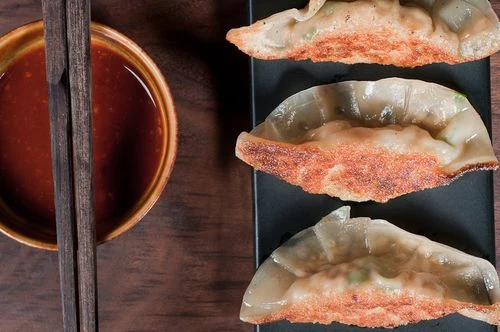
Mandu - Korean-Style Potstickers with Ssamjang / Kochujang Sauce - Recipe
This post contains affiliate links; if you buy through them I may earn a small commission at no cost to you. Learn more.
I never grow tired of potstickers, but I thought it might be time to branch out from my standard recipe. My friend Hsiao-Ching had told me about about a sauce from the Momofuku cookbook involving kochujang, ssamjang (two standard Korean kitchen staples), oil, and sherry vinegar. So that put me onto the idea of Korean-style potstickers, and sure enough, there are many kinds.
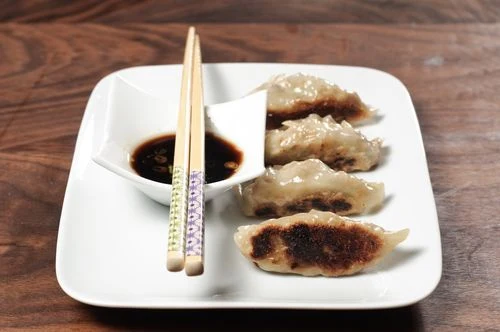
The generic name for Korean dumplings is mandu (sometimes spelled mandoo); when they are panfried, they become gunmandu. And apparently vegetarian dumplings would be somandu.
The filling I used is a combination of tofu, tempeh, blanched bean sprouts, green onion, and egg, seasoned with soy sauce and sesame oil. This is the first time I’ve used egg in a filling and I really enjoyed the results. it binds the whole interior into a slightly fluffy but firm bite. Tempeh is not a traditional Korean ingredient but I find it adds a great toothsome quality to vegetarian dumplings.
To form the dumplings I used this cheap, simple little dumpling press (or try this one) for the first time. Life changing event. In the past, I’ve always had trouble getting those pretty little pleats and a perfect seal. Now it is child’s play. Literally - my kiddo made a bunch of them and they turned out perfect. Hsiao-Ching said that I need a dumpling lesson, and rightly so. It would be much more satisfying to learn the traditional skill. But in the meantime, I’m pretty psyched about the press!
You’ll need either a Korean grocery or a well stocked general Asian grocery (such as Uwajimaya in the Seattle or Bay Area) to find kochujang and ssamjang. They are delicious and well worth searching out. Since I’ve picked them up, I use them in everything. I also used black vinegar instead of sherry vinegar in the sauce, so you might want to get that as well. It has a slight five-spice flavor that I love.
For the sauce:
- 1/4 cup kochujang
- 1/3 cup ssamjang
- 1/3 cup black vinegar
- Whisk together all ingredients. Add water as needed to reach a dipping sauce consistency. Taste and add more vinegar if desired.
- 1 cup mung bean sprouts
- 1 cup extra firm tofu
- 1/2 cup vegetable oil, divided
- 8 ounce tempeh
- 4 green onions, white and light green parts, sliced thin
- 3 cloves garlic, minced
- 1/4 cup tamari (soy sauce)
- 4 teaspoons Asian (toasted) sesame oil
- 2 egg, beaten
- 1 package (around 40) potsticker wrappers - I prefer the kind labeled "thick"
- Blanch the mung bean sprouts in a small pot of boiling, salted water for 1 minute. Drain, chop roughly, and squeeze out as much moisture as possible using a clean kitchen towel. Crumble the tofu and squeeze the water out of it as well.
- Slice the tempeh into thin slabs and pan fry in 2 tablespoons of the vegetable oil until golden brown on both sides. Crumble.
- Thoroughly combine the bean sprouts, tofu, tempeh, green onions, garlic, tamari and sesame oil. Taste and adjust seasoning as needed. Then mix in the beaten eggs.
- To form the dumplings, take a wrapper and put about 2 teaspoons of filling in the center. Moisten the edge, fold, and seal firmly. Optionally, you can pinch to form pleats. Or use the dumpling press I mentioned above. Do not overfill, it will make it impossible to get a tight seal.
- To fry the dumplings, heat a large skillet over a medium high flame. Add 2 tablepoons of oil, then put in about 1/3 of the dumplings, pleats pointing up. Press down a little to create a flat spot. Be sure the dumplings aren't touching. Fry for about 60-90 seconds until golden brown on the bottom. Carefully add in about 3 tablespoons of water, lower the heat, and put on the lid. Cook about 3 minutes. Remove the lid, cook off any excess water, and then remove the dumplings with a spatula. Repeat with the remaining dumplings.
- Serve immediately with the dipping sauce on the side.
18 Comments
Comments are closed.